On the Place of Coffee in a Restaurant
The article
Mofusan
By Morgan de Polignac, Jun 15, 2026The French are among the world's biggest coffee drinkers. In a restaurant, coffee may look like an optional afterthought, a matter of tradition at the end of a menu, yet it matters a great deal, because it brings the whole meal to a close. Coming as it generally does after a dessert or something sweet, its flavour — often aromatic — its slight bitterness and its proven digestive properties make it an excellent part of an experience built on taste.
All the same, the quality of coffee in restaurants is often neglected, for although it is an easy margin for restaurateurs, a bad coffee can spoil a guest's experience even after an excellent meal. Conversely, an excellent coffee — or at the very least a good one — never fails to be remarked upon.
After discovering slow brewing methods, roasting and cupping (tasting brewed coffees to establish their aromatic profile), a whole world opened up in terms of how I perceived flavour. I have been fortunate enough to meet a number of speciality coffee roasters, passionate craftspeople with whom I have carried out many tastings and experiments, refining my palate and my pleasure in taste ever further.
What is speciality coffee? It is a coffee of great quality, given a score out of 100 by the SCA (Speciality Coffee Association). A speciality coffee must score at least 80 out of 100.
From there, the roaster's work in sourcing green coffee is essential, for it is the foundation of the final result. The roaster will then test and devise a roasting profile suited to each coffee.
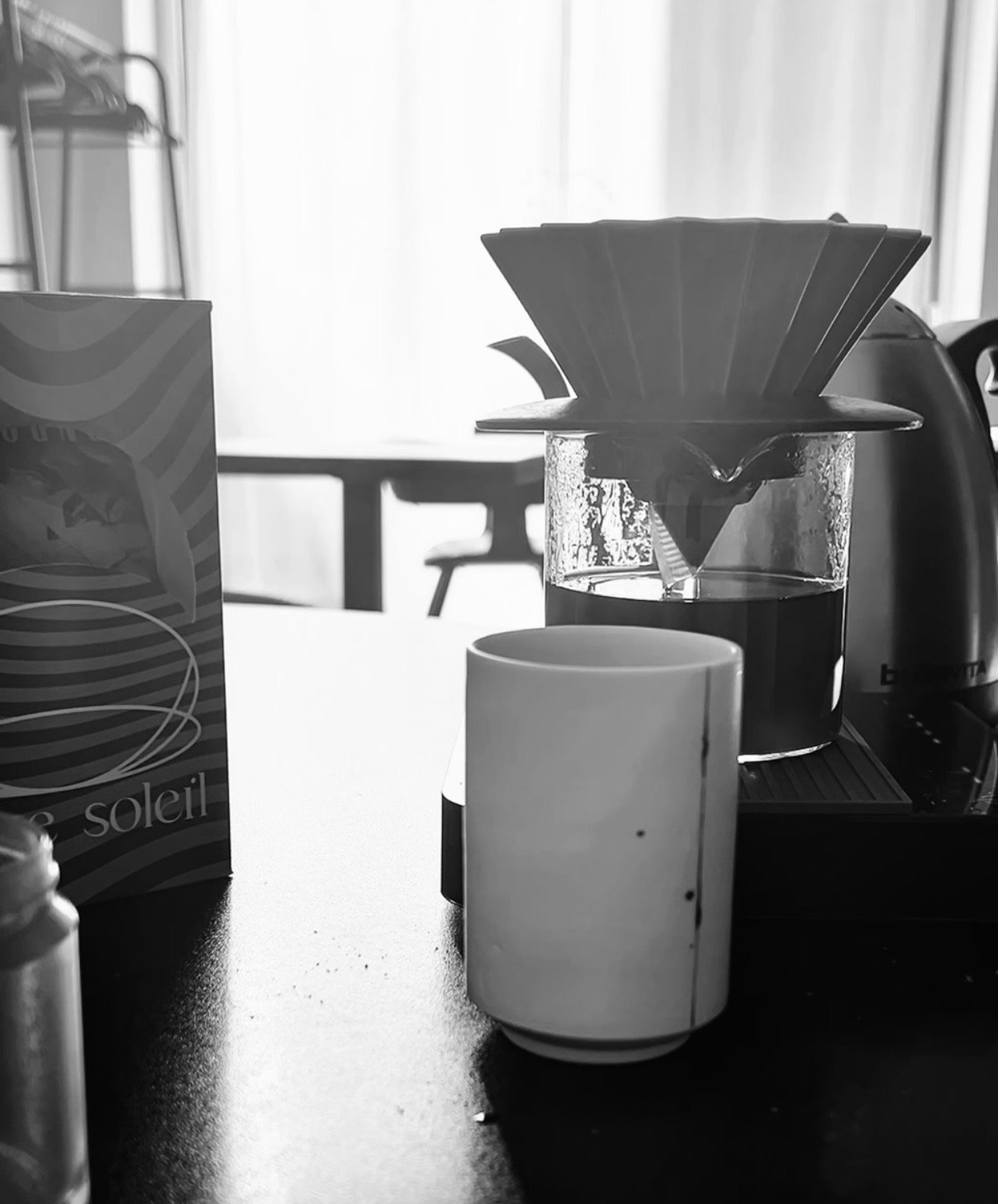
Finally comes grinding, and then extraction. The best known method is percolation (found in most places serving coffee), but there are also the slow methods (filter brewing), of which there are a good many, depending on the notes you wish to draw out of each coffee.
For any given coffee, a recipe is worked out in order to develop its aromas as fully as possible.
There is a whole range of brewers and filters. It is essential, too, to pay attention to the grind, to the temperature of the water and its quality, and to the extraction process (water-to-coffee ratio, pouring technique…).
It is a great pleasure at Mofusan to offer both espresso and slow brewing methods, regularly selecting excellent coffees from a range of speciality roasters, so as to give this part of the meal the place it deserves.
One espresso and several filter coffees are on offer, including a decaffeinated filter coffee — which is relatively rare, since filter coffee calls for a lighter roast than espresso.
For each coffee, a recipe is created around a particular filter, in order to draw the best from the profile of every coffee we select.
It is a passion for sourcing, for roasting and for flavour that makes every meeting with a roaster an opportunity to select exceptional coffees, which we have chosen to share with you.
We have chosen to brew by slow methods at the table, to create a moment of genuine sharing, to describe the origin of each coffee, and to explain to the uninitiated the point and the process of the method chosen for it.
We regularly taste and select distinctive, traceable coffees in advance, so as to give you the best possible experience.
If you are wary of caffeine, particularly in the evening, we have a decaffeinated coffee specially roasted for us and served by slow brewing at the table, to preserve its aromatic profile.
As with every product served at Mofusan, this precise selection — made in keeping with the cooking and with a single menu shaped by the inspirations of the moment — forms a particular and assertive world of its own, to be discovered anew at every visit.
Discover more articles

Mofusan: the Spirit of Taste and Surprise
August 24, 2026
—
Mofusan
A guest, who has since become a friend, offered to write a piece about the experience at Mofusan. Enjoy. Mofusan: the spirit of taste and surprise There are restaurants where you go to have dinner. And then there are those where you go to live an experience. At Mofusan, the experience begins…
A Short Culinary Portrait
June 3, 2026
—
Mofusan
A culinary portrait It is with undisguised pleasure that I play along with this little questionnaire. Your madeleine de Proust: xiaolongbao (Chinese steamed soup dumplings), and praline. A fruit – rambutan, and durian A bottle – huangjiu ("yellow wine"), made by hand in the old way and served warm…